
Watauga Directory Collections
Watauga does not appear as a stand-alone title in the Texas State Library and Archives Commission list. Its entry says to see Fort Worth Suburban, a regional R.L. Polk & Co. run. That catalog choice matters. A search limited to a modern city name can miss the principal historical directory lead. The Texas State Library list is the best coverage guide, while the UT Briscoe catalog is a second physical-collection lead with a smaller selected run. The table separates a confirmed holding from an online search tool that does not establish a Watauga entry.
| Collection | Years | Where Held | Access |
|---|---|---|---|
| Fort Worth Suburban City Directory, R.L. Polk & Co. | 1963-68, 1970-79, 1981-82, 1985, 1987-88, 1990-91, 1993 | Texas State Library and Archives Commission list | Catalog online; printed or microform use in the Austin Reading Room |
| Fort Worth Suburban catalog record | Jan. 1963, 1965, 1967, 1968, 1971, 1975, 1991 | UT Briscoe Center | Online catalog and physical collection |
| Regional telephone directories | Exact Watauga years not located | Regional directory holdings | Supplementary search only; a Fort Worth-area listing does not prove a Watauga entry |
| City directories and maps | Exact Watauga volume list not located | Tarrant County Archives | Ask an archivist for the relevant street or subdivision material |
| UNT city-directory collection | Collection spans 18 decades | Portal to Texas History | Online full-text and metadata search; no Watauga-specific item was located |
The listed Polk run has real gaps: 1969, 1980, 1983-84, 1986, 1989, and 1992 are not shown. A missing volume is not a missing person. Confirm the physical volume before drawing a conclusion from any gap.
Fort Worth Suburban Catalog Trap
The regional title is the first Watauga directory quirk to preserve. Texas State Library and Archives Commission directs researchers from Watauga to Fort Worth Suburban, and the Briscoe record identifies Watauga among the places covered. Start with the locality heading, then try the title, surname, street spelling, and nearby place headings. The Briscoe search supports location, directory type, year range, and browse choices, so it is useful for checking whether a selected January volume is cataloged.
Texas State Library and Archives Commission's directory list shows the Watauga cross-reference under the regional title.
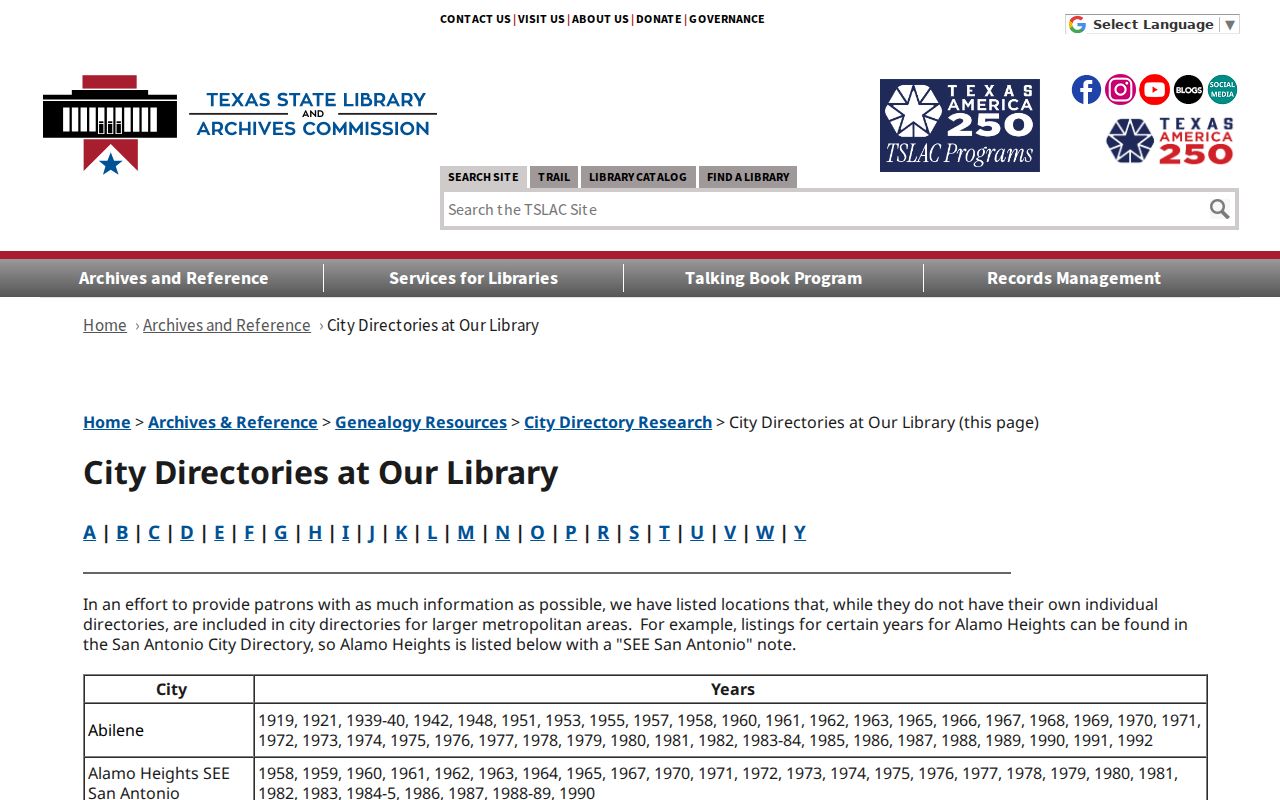
That catalog relationship is why a Watauga search should not end after a stand-alone title fails. The State Library guide also directs readers to its Reading Room because staff cannot conduct a full directory search or transcription by phone or email.
Use the State Library contact route for access questions at ref@tsl.texas.gov or 512-463-5455. The UT Briscoe directory index is the parallel online catalog route, not a substitute for inspecting a volume.
Watauga Directory Years and Gaps
The Polk listing should be read as a documented run, not a promise of an annual Watauga city directory. The known sequence omits 1969, 1980, 1983-84, 1986, 1989, and 1992. Publisher changes, catalog practice, local coverage, and surviving-volume access can all affect the shelf. Search the years on either side of a gap, then compare the street, spouse notation, telephone, and deed trail rather than treating a missing year as proof that a household vanished.
Watauga was incorporated in 1958, so the regional Fort Worth Suburban heading is a key later-period term. Earlier material may use rural, station, post-office, railroad, or nearby-community wording. That records geography is why a city directory query should include the regional title and a known subdivision or street variant when possible.
Watauga Directory Access Routes
Watauga Public Library is the local referral point for a historical directory question. Its reference desk can check current local-history, newspaper, obituary, yearbook, microfilm, and directory holdings; it can also explain scanning, copying, interlibrary loan, and licensed database access. The exact local directory shelf run and a named Watauga obituary index were not located in the official material, so ask about a particular title and year rather than assuming a volume is on hand. Library cardholders can use listed resources remotely where allowed, while Ancestry Library Edition is available in the library only.
Watauga Public Library's database page describes cardholder and in-library access options.
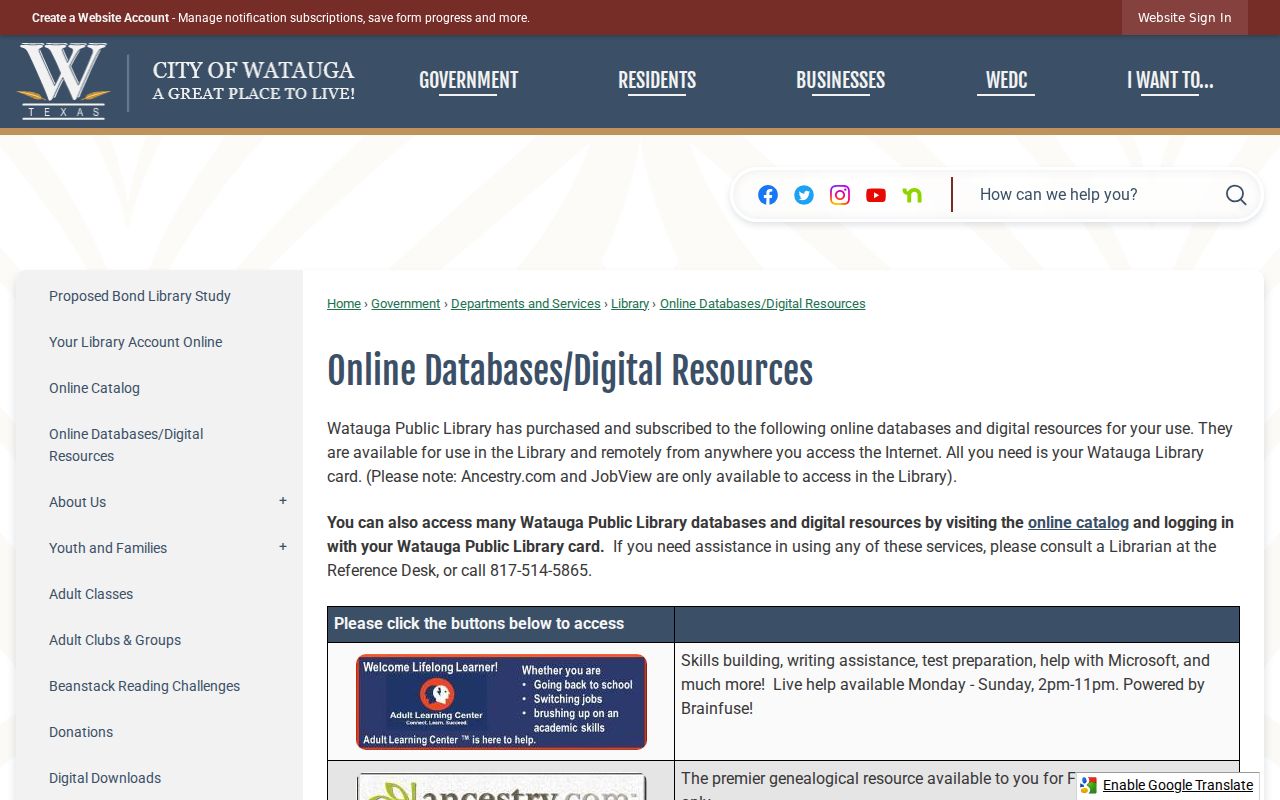
The image reflects the library access route, not proof that a particular Watauga directory is digitized. Contact the reference desk at 817-514-5865, or visit 7109 Whitley Road during its posted hours: Monday and Thursday noon-8, Tuesday, Wednesday, and Friday 10-6, and Saturday noon-4.
For older county-scale material, Tarrant County Archives genealogy holdings add Footprints, maps, directories, school census, probate abstracts, cemetery records, and pre-1900 marriages. Archives accepts walk-ins Tuesday through Friday, 9-4:30, with Monday appointments, and can be reached at 817-884-3272 or archives@tarrantcountytx.gov.
Watauga does not publish a public resident database or a separate city archive index. For a city-held historical report, permit file, code record, or correspondence that has no public index, use the City of Watauga public-information request route. Identify the record, date range, location, department, and whether inspection or copies are preferred.
Watauga Directory Digital Routes
Digitized searching is valuable for regional context, but it has a clear limitation here. The UNT Portal to Texas History collection reports 361 items, 22 partners, 18 decades, and 16 counties, with full-text, metadata, title, subject, creator, name, guided, advanced, and proximity search modes. It reports 11 Tarrant County items, yet the inspected collection did not expose a Watauga-specific directory. Treat a digital hit as a lead that needs title, place, and page verification.
UNT's city-directory collection provides the available digitized search controls and collection metadata.
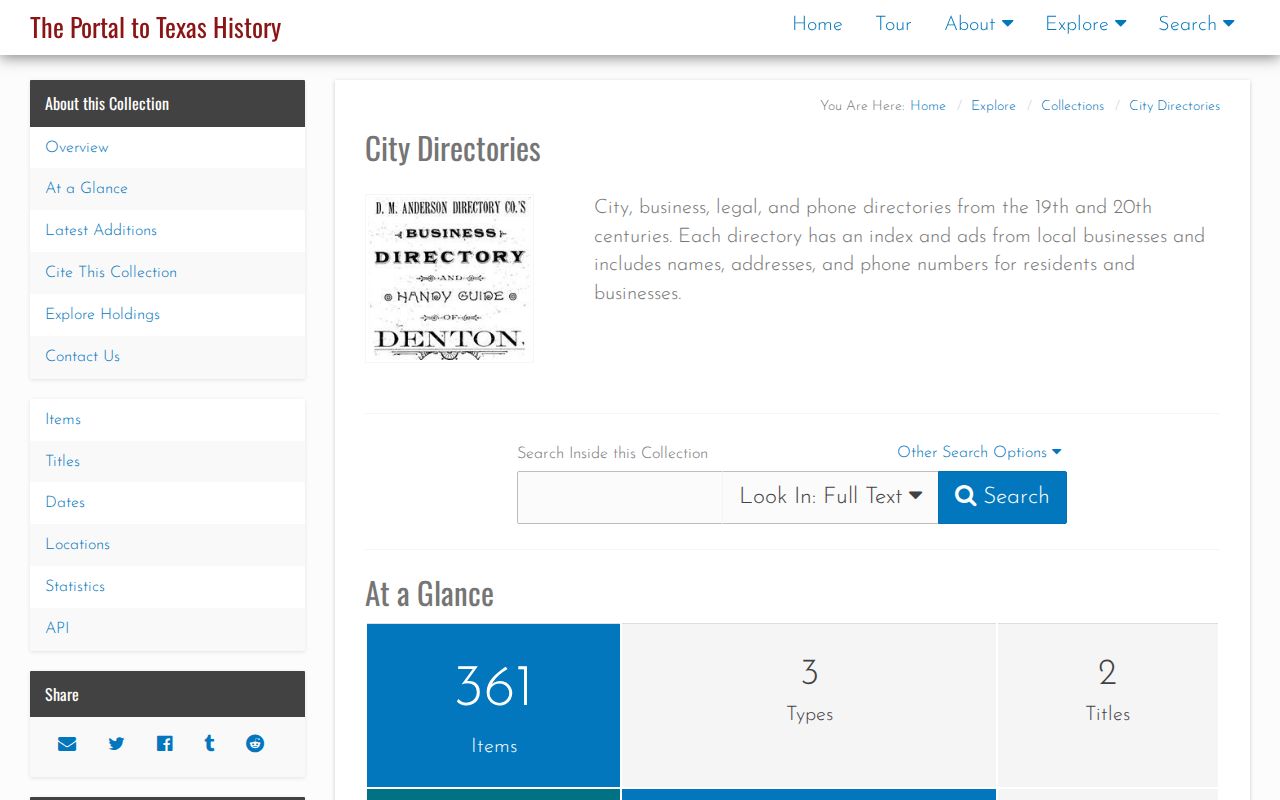
Online searching and physical shelves serve different parts of the trail. A failed full-text search may reflect OCR, a catalog title, or an undigitized volume, so the State Library, library reference desk, and Archives remain necessary access channels.
Note: No official Watauga-specific digitized directory item was located, so an online result should be cited by its exact title and locality rather than treated as a complete run.
Reading a Watauga City Directory Entry
An entry should be copied as printed, including abbreviations and punctuation. The State Library guide says a typical directory can carry a person’s name, street address, telephone, spouse, occupation or affiliation, owner or renter notation, and widow notation. An actual Watauga scan was not publicly available during the research pass, so no sample resident should be invented. Instead, photograph or cite the volume title, publisher, year, page, locality heading, printed name, address, and every mark visible on the page.
| Name | The printed name and initials; preserve spelling variants for later catalog and record searches. |
|---|---|
| Street and telephone | An address and telephone can anchor the household to a particular publication period. |
| Spouse or widow notation | A relationship mark can explain a surname change or help separate similarly named people. |
| Occupation or affiliation | A historic context clue, not proof of a present-day connection. |
| Owner or renter mark | A period label that should be checked against a deed before making an ownership claim. |
- Criss-cross directory
- The address-order portion of a volume, used to move from a street number to a listed occupant.
- Householder index
- An alphabetical index organized around the person or household named by the directory publisher.
- Abbreviation key
- The volume’s explanation of shortened marks. Copy it before interpreting any label in an entry.
A directory entry is a periodic snapshot. It may suggest that someone was listed at an address when published, but it cannot establish a current resident or replace a deed, certificate, or court record.
Watauga Directory Timeline
Watauga’s place history explains the catalog pattern. Before incorporation, an old record can use rural, station, post-office, railroad, or neighboring-community wording rather than a modern city address. After incorporation, the Fort Worth Suburban heading is the documented directory route. County history adds another limit: early Tarrant deed and district material was damaged in the 1876 courthouse fire, while probate and some other records survived. That history makes a blank early result a prompt to check archives, not a final answer.
| 1849 | Tarrant County was established, with Fort Worth as county seat and later records center. |
|---|---|
| 1876 | Courthouse-fire accounts document major early deed and district-record loss, with some probate material surviving. |
| 1883 | A Watauga post office was established after the late-nineteenth-century railroad era. |
| 1958 | Watauga incorporated, making the Watauga and Fort Worth Suburban locality terms especially useful after this point. |
| 1963-1993 | The documented Fort Worth Suburban directory run begins in 1963 and ends at a listed 1993 volume, with gaps. |
Research the conflict in early history carefully. City material references a railroad arrival in 1877, while the Texas State Historical Association describes an extension in 1881. Those accounts support broad search terms, not a manufactured address conversion.
Tracing Watauga Households
To trace a household, begin with the earliest confirmed printed name, then preserve each change rather than smoothing it away. Compare the first listed years such as 1963, 1965, 1967, and 1968 before moving through the later volumes. The reverse or criss-cross section, when present, can test an address even when a surname is uncertain. Pair a directory year with the deed trail and a federal census release that is actually public. Federal census records are public through 1950 under the 72-year schedule; the 1960 census is not public as of 2026.
- Record the directory year, exact printed name, spouse notation, address, telephone, affiliation, and each owner or renter mark.
- Check the next available listed year, not an assumed missing year, and note whether the name, telephone, or street number changed.
- Use the address-order section where available to compare the printed household with nearby listings.
- Match a move or ownership clue with a recorded instrument, map, or legal description, keeping the source date beside each fact.
- At the older end of the trail, consult the public census, Footprints, probate abstracts, cemetery records, and newspapers through the library or Archives.
A disappearance can mean a move, a death, a changed listing practice, or an unlisted household. For a current address-keyed record rather than a historic snapshot, use the Watauga Streets reference and verify the result with the custodian.